

EU Drives Down Lightweight Plastic Carrier Bag Usage, On Track for 2025 Waste Reduction Target
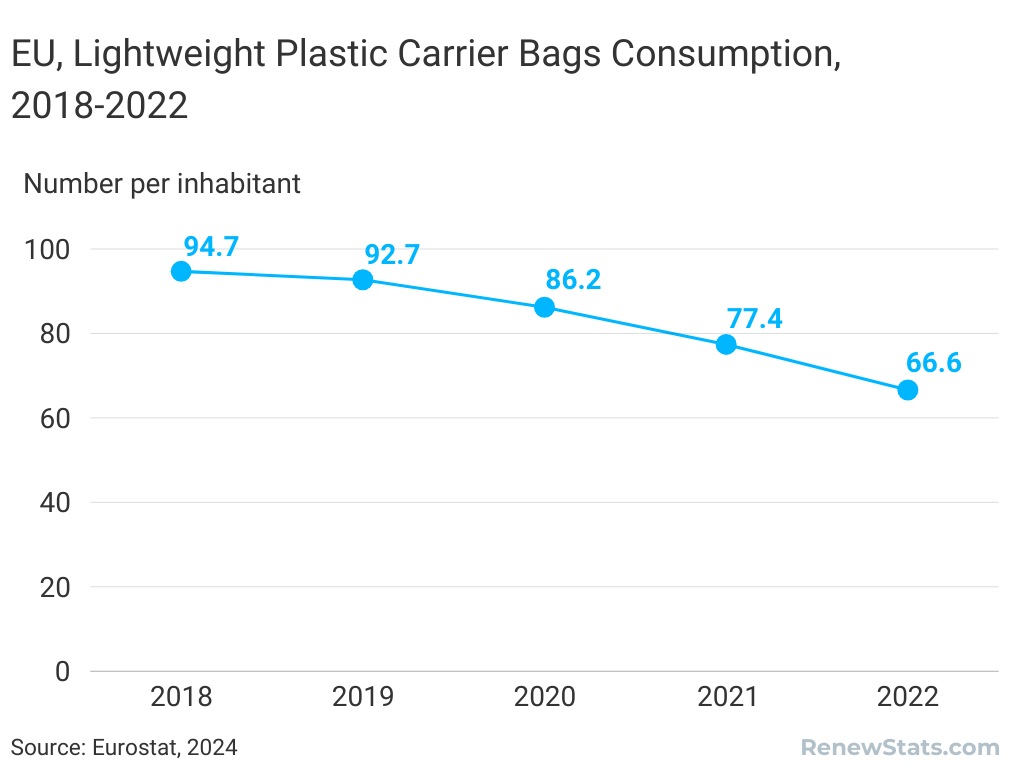
In a significant step toward minimizing plastic waste, the European Union (EU) reported a 14% decrease in the use of lightweight plastic carrier bags (LPCBs) across its member states in 2022. New data from Eurostat reveals that average per capita consumption fell to 66.6 bags, a reduction of 10.8 bags per person from the previous year. This decline corresponds to an overall drop of 12.4 billion plastic bags from the EU market since 2018.


Source dataset: EU_Lightweight_Plastic_Carrier_Bags_Consumption,_2018-2022
This progress marks a critical advancement in the EU’s sustainability strategy, aligning with the Plastic Bags Directive—a policy framework that aims to cut LPCB usage to 40 bags per capita by 2025. The directive focuses specifically on lightweight bags under 50 microns thick, while exempting very lightweight plastic carrier bags (VLPCBs) of less than 15 microns, which are often used for produce.
Shifting Trends: Consumption Varies Across EU Member States
While the EU has made strides in reducing plastic bag waste, consumption levels continue to vary widely among member countries. Lithuania, for instance, reported the highest per capita use, with an average of 249 bags per person, largely driven by VLPCB consumption. Other high-use countries included Latvia and Czechia, with averages of 193 and 185 bags per person, respectively. These countries still face challenges in cutting reliance on single-use plastics, particularly the thinner VLPCBs, which remain popular due to their cost-effectiveness and convenience.
In contrast, some EU nations are leading the charge in cutting down on LPCB consumption. Belgium, Poland, and Portugal recorded the lowest usage rates, with just 4, 7, and 13 bags per person, respectively. These countries are already far below the EU’s 2025 target, underscoring the effectiveness of their local policies and public initiatives aimed at reducing plastic waste.

Source dataset: EU_Lightweight_Plastic_Carrier_Bags_Consumption,_2018-2022
Consistent Reduction Points to Policy Success
The latest data highlights a strong downward trend in LPCB consumption since 2018. The EU-wide per capita usage rate has steadily decreased, starting from 94.7 bags in 2018, moving to 92.7 in 2019, then down to 86.2 in 2020, and further to 77.4 in 2021. The reduction to 66.6 bags in 2022 signals that the EU’s policy interventions and public awareness campaigns are generating lasting impacts.
This sustained reduction reflects the success of the Plastic Bags Directive, which not only sets ambitious goals but also provides a structured path for EU countries to adopt local regulations that limit plastic waste. The directive’s emphasis on reducing plastic bag consumption reflects the EU’s dedication to a circular economy, a model designed to foster resource efficiency and minimize environmental impact.
Detailed Overview of Europe’s 2022 LPCB Consumption by Country (Number per inhabitant)
| Country | VLPCBs (<15 microns) | LPCBs (15-49 microns) | Total LPCBs (<50 microns) |
|---|---|---|---|
European Union – 27 countries (from 2020) | : | : | 66.6 |
| Belgium | 1.3 | 2.6 | 3.9 |
| Bulgaria | : | : | 131.6 |
| Czechia | 176.5 | 9 | 185.5 |
| Germany | 30 | 4.6 | 34.7 |
| Estonia | 81.7 | 42.3 | 124 |
| Ireland | 44 | 1.6 | 45.6 |
| Greece | 27.5 | 56.2 | 83.7 |
| Spain | 74.4 | 20.2 | 94.6 |
| France | 42.8 | 3.9 | 46.8 |
| Croatia | 89 | 7.7 | 96.7 |
| Italy | : | : | 121.6 |
| Cyprus | 77.4 | 85 | 162.4 |
| Latvia | 150.3 | 42.3 | 192.6 |
| Lithuania | 208.4 | 40.8 | 249.3 |
| Luxembourg | 3.8 | 19.7 | 23.5 |
| Hungary | 81.6 | 5.9 | 87.4 |
| Austria | 14.2 | : | 14.2 |
| Poland | : | : | 6.6 |
| Portugal | : | : | 13.2 |
| Romania | : | : | : |
| Slovenia | 61.3 | 13.2 | 74.5 |
| Slovakia | 68.7 | 7 | 75.7 |
| Finland | 62.5 | 55.7 | 118.2 |
| Sweden | 2.9 | 16.7 | 19.7 |
| Iceland | : | : | 36.6 |
| Norway | 49.5 | 169 | 218.5 |
Looking Ahead: Aiming for 40 Bags Per Person by 2025
As the EU continues to push toward its 2025 LPCB target of 40 bags per capita, member states are doubling down on policies to foster a sustainable transition. Initiatives such as plastic bag bans, levies on single-use plastics, and incentives for reusable alternatives are playing pivotal roles in reshaping consumer habits. By tracking metrics like per capita LPCB usage, the EU aims to demonstrate that practical, policy-driven solutions can produce measurable outcomes in the fight against plastic pollution.
This progress on plastic reduction dovetails with the EU’s broader environmental policies, reinforcing its leadership in global sustainability efforts. The directive, with its clear milestones and country-specific data monitoring, serves as a roadmap for reducing single-use plastic across the EU and beyond, positioning the region as a model for a sustainable, circular economy.
Source: Eurostat
You May Also Like


Something went wrong. Please refresh the page and/or try again.
biomethane biogas Ukraine European Union Europe
energy storage solar energy united states