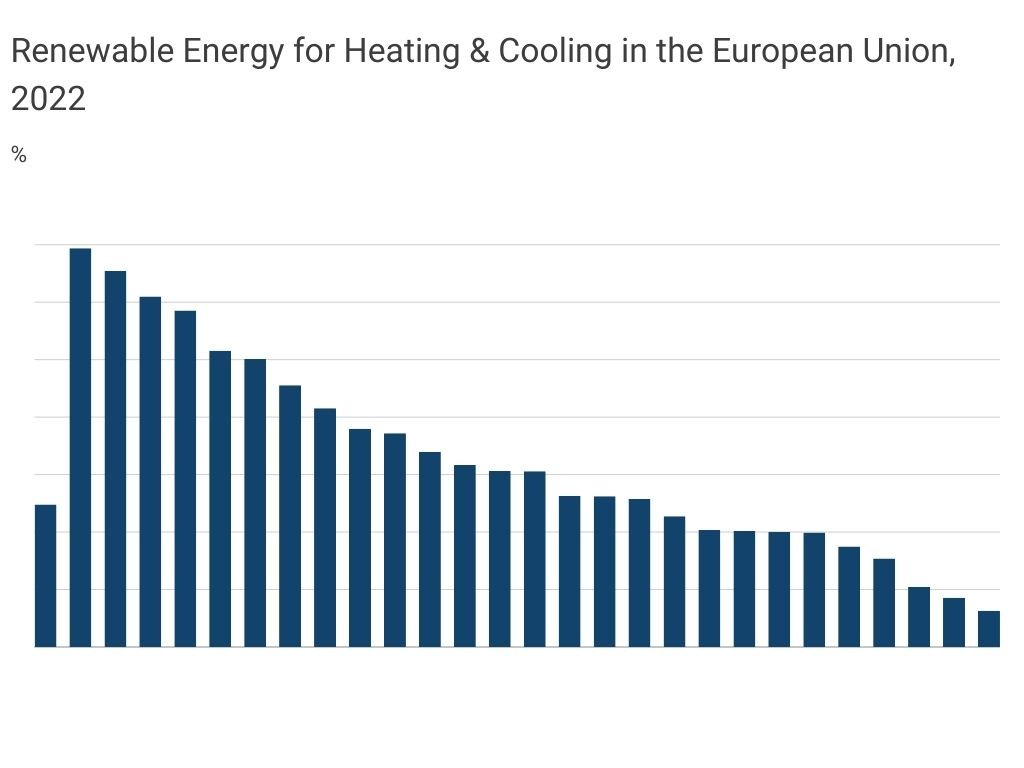
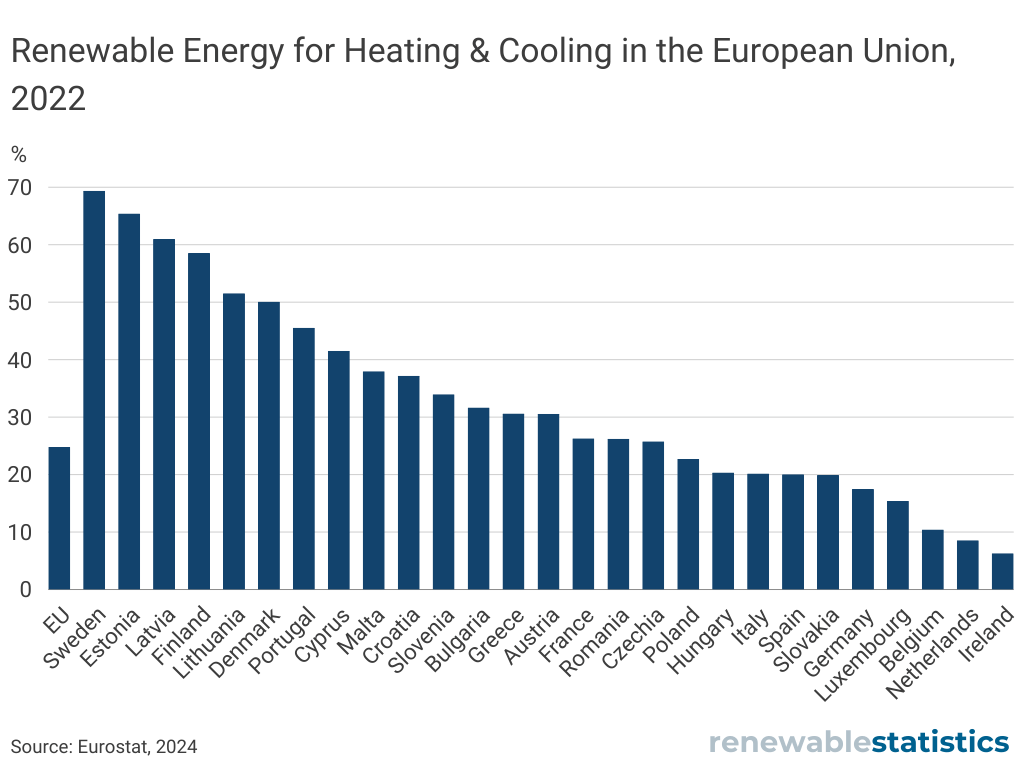
Energy for heating and cooling constitutes about half of the EU’s gross final energy consumption. In 2022, the share of renewable energy in heating and cooling increased to 24.8%, marking a 1.8 percentage point (pp) rise from 2021.
Leading in the adoption of renewables for heating and cooling, Sweden achieved a 69.3% share, followed by Estonia at 65.4% and Latvia at 61.0%. Sweden and Estonia predominantly utilize biomass and heat pumps. Latvia primarily relying on biomass. Conversely, the lowest shares were recorded in Ireland (6.3%), the Netherlands (8.6%), and Belgium (10.4%).
The most significant increases compared to 2021 were observed in Malta (+5.2 pp), Luxembourg (+2.5 pp), and Ireland (+1.4 pp). Conversely, decreases were noted in Austria (-2.4 pp), Slovenia (-1.2 pp), and Cyprus (-1.0 pp).
Over a decade, the average percentage of energy from renewables for heating and cooling rose from 18.6% to 24.8% (+6.2pp). However, meeting the new targets set by EU Directive 2023/2413 requires EU countries to increase their yearly average share of renewables in heating and cooling by at least 0.8 pp from 2021 to 2025 and at least 1.1 pp from 2026 to 2030.
Raw data used for the charts and sources information (Download dataset)
Cite Chart: RenewStats.com. (2024). Renewable Energy for Heating & Cooling in the European Union, 2022. Retrieved from https://renewstats.com/region/europe/2024/03/07/renewable-energy-heating-cooling-european-union/
show less